
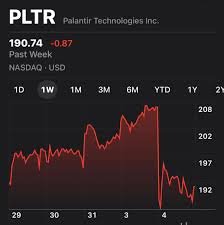
Palantir Technologies has become one of the most closely watched companies in the modern data-analytics landscape. Known for its work with government agencies, national security organizations, and an expanding list of commercial clients, the company has carved out a unique position in the software world. As a result, Palantir stock has drawn significant investor attention, often sparking debate about whether it represents a powerful long-term growth opportunity or a richly valued speculative bet. Understanding the stock requires looking at Palantir’s business model, competitive strengths, challenges, and the broader context of AI-driven enterprise software.
A Company Built on Data and Decision-Making
Palantir’s entire mission revolves around enabling institutions to make better decisions with massive, complex data. Its flagship platforms—originally Palantir Gotham for government intelligence use cases and later Palantir Foundry for commercial enterprises—help clients integrate disparate data sources, analyze information at scale, and take real-time action.
In recent years, the company has doubled down on artificial intelligence, introducing the Palantir Artificial Intelligence Platform (AIP). This product has become a central talking point for investors, as it positions Palantir as a fundamental operator in the increasingly competitive AI software ecosystem. Unlike companies that develop generalized consumer AI products, Palantir sells mission-critical enterprise platforms that embed AI directly into operations, logistics, manufacturing, supply chain optimization, and defense technology.
This focus on high-value, high-complexity applications is a major part of the stock’s appeal. It creates a business that’s difficult to replicate and provides the company with deep, sticky relationships across both public institutions and private industry.
The Government Foundation—and Its Dual-Edged Nature
Palantir’s early and continuing reliance on government contracts is both a major strength and a source of debate among investors. On one hand, long-term defense and intelligence contracts provide revenue stability and reinforce Palantir’s reputation as a mission-critical partner. Government partnerships also tend to come with high switching costs, meaning once Palantir becomes integrated, agencies rarely move to competing platforms.
On the other hand, the stock has sometimes come under pressure due to concerns about concentration risk. A meaningful portion of Palantir’s revenue still comes from U.S. and allied governments. Although this base is expanding, some investors prefer companies with broader commercial diversification. Additionally, government budgets and procurement cycles can be unpredictable, creating occasional volatility in expectations.
Still, many analysts consider Palantir’s government foothold an invaluable competitive moat rather than a liability. It gives the company credibility, security certifications, and experience with large-scale deployments that few competitors can match.
Commercial Expansion and AIP’s Growing Role
What excites many Palantir investors today is the company’s accelerating commercial adoption. Over the last several years, Palantir has invested heavily in expanding its presence across healthcare, automotive, energy, manufacturing, and financial services. The launch of AIP has further catalyzed interest, particularly as enterprises look for ways to integrate AI into existing systems securely.
A key factor behind Palantir’s commercial momentum is its deployment model. Instead of requiring a long, costly integration process, the company has increasingly shifted toward modular, rapid-deployment approaches. This allows clients to start small—sometimes with short-term pilot programs—and scale up as value becomes clear. The strategy has been effective in reducing friction and broadening Palantir’s potential customer base.
If Palantir continues to accelerate commercial revenue growth, it could significantly strengthen the long-term story behind the stock. Investors generally view the commercial segment as the company’s most scalable growth engine.
Profitability and Operating Leverage
One of the biggest criticisms Palantir faced following its public listing was its lack of profitability. However, over time the company has demonstrated improving margins and increasing operating discipline. As Palantir’s business model matures, it benefits from operating leverage—meaning that once software is developed, it can be deployed repeatedly at low incremental cost.
This shift toward sustained profitability has made the stock more appealing to a broader range of investors. A company once viewed as a speculative, long-term bet is increasingly perceived as a stable and maturing enterprise software provider.
Valuation: A Persistent Debate
The valuation of Palantir stock remains a point of contention. Supporters argue that Palantir deserves a premium price because it operates at the intersection of AI, national security, and data analytics—industries with massive long-term potential. They also emphasize the company’s expanding commercial footprint, improving profitability, and differentiated technology stack.
Skeptics often counter that the stock trades at a high multiple relative to current revenue and earnings, implying that the market has already priced in much of its future growth. They caution that while Palantir’s technology is impressive, competition in the enterprise AI space is intensifying, and maintaining rapid growth may become more challenging.
Regardless of which side one takes, the valuation conversation reflects Palantir’s high-expectation environment. It is a stock that tends to attract investors with a long time horizon and an appetite for innovation-driven growth stories.
Competitive Landscape and Market Position
Palantir does not operate in isolation. It faces competition from major cloud providers, large enterprise software firms, and numerous emerging AI companies. Yet its position remains relatively unique. While others offer general-purpose tools, Palantir emphasizes full-stack, end-to-end solutions that integrate deeply into client operations.
This approach is resource-intensive, but it provides differentiation. Clients who adopt Palantir often rely on its software for critical functions, reducing the likelihood of switching. The company’s combination of government-grade security, customizable AI workflows, and large-scale data integration continues to be a significant advantage.
Long-Term Outlook
The long-term potential of Palantir stock depends on several factors:
1. Continued commercial momentum
If the company can grow its commercial customer base while maintaining strong margins, it may enter a new phase of expansion.
2. Adoption of AIP
The success of AIP could play a central role in determining whether Palantir becomes a major force in enterprise AI.
3. International growth
Palantir’s expansion into Europe, Asia, and beyond may unlock a new wave of demand.
4. Regulatory and political considerations
Because of its deep ties to government and defense, Palantir must navigate political and ethical scrutiny.
Overall, Palantir appears positioned at the forefront of AI-driven enterprise software, but the stock’s future performance will depend on its ability to execute consistently, diversify revenue, and maintain technological leadership in a fast-moving industry.
